

Search This Blog

Total Pageviews

Advertisement

Labels

Showing posts with label climate refugee. Show all posts

PNG seeks climate collaboration from industrialised nations

Papua New Guinea's prime minister James Marape is to raise climate change and the threat to his country's biodiversity at the UN.

Marape has arrived in New York to speak at the United Nations General Assembly for the first time on Friday, when the prime minister said he would also speak on behalf of small island states.

Villagers have resorted to using tires and barrels for protection
 from the sea 
Photo: RNZ Pacific / Koro Vaka'uta

Marape said he hoped industrialised countries will help PNG to conserve its great biodiversity by mitigating the threat climate change poses.

He suggests that global climate fund institutions who repeatedly tell PNG to preserve its native forests should in exchange finance basic services in his country.\

Marape pointed out that although PNG has a large land mass, it has close to 600 outlying islands and was qualified to speak about climate change.

"We were the first country in the world to relocate climate change refigees, from the Carteret Islands.

"Papua New Guinea, including the 15 other smaller Island States in the Pacific, do not emit a lot of carbon into the atmosphere and yet they are paying the price," he said.

"Relocating the people of Kiribati, who are slowly losing their land to sea water to another land mass that is not a part of their own country is a plan that they are against as well.

"Their island is sinking but the people have chosen to stay. The world must do something. We should also cite the Caterets as well."

NG Prime Minister, James Marape (right) had a meeting with the UK's Alok Sharma, UNFCCC COP26 President Designate. New York, 21 September, 2021. Photo: PNG PM Media

"Since the Kyoto Agreement and now the Paris Accord, industrialised countries have never tried to push hard to implement the agendas agreed to in the agreements."

Marape is urging industrialised nations, to do more and to work together with communities affected by deforestation and climate change "to find a viable and sustainable way forward to achieve the SDG's as well as the Paris Accord, without compromising the development aspirations of developing country, especially the smaller Island States".

"Papua New Guinea has one of the last standing rainforests in the world and if you want me to conserve it, create an opportunity for my people and country to grow without affecting the conservation of the rainforest.
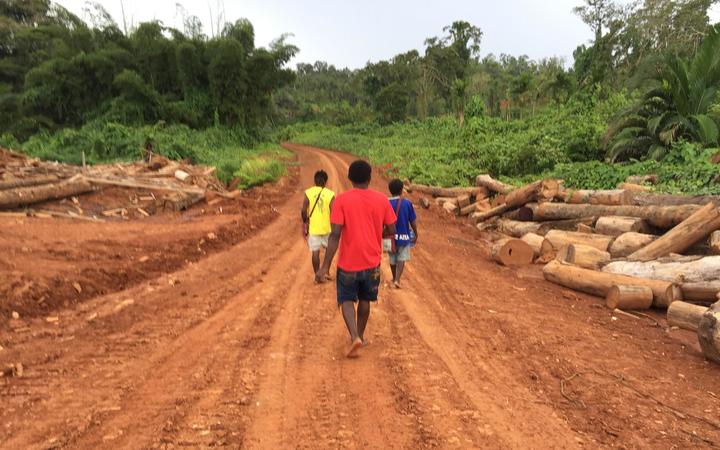
Landowners walking along a logging road in
an illegally logged forest, Metamin area,
New Hanover, PNG. Photo: Global Witness Media Hub

PNG has struggled to contain illegal logging over recent decades, but the government is seeking more benefits from licensed logging, with Marape recently telling foreign logging companies to start downstream processing activities in PNG or leave the country.

"Our rainforest is the oxygen factory of the world, therefore, it is a global asset. To conserve, we must all work together to find a balance that will preserve the rainforest while improving livelihood."

According to the PNG government, data taken from the Global Forest Watch Forest Monitoring programme has revealed that only 36 percent of earth's 14.6 million square kilometres of tropical rainforest remain intact.

The balance of 64 per cent is either degraded or completely gone.

Source: RNZ

Decolonize climate adaptation research


Climate-forced population displacement is among the greatest human rights issues of our time, presenting unprecedented challenges to communities and the governments responsible for protecting them. Sea level rise, heat, drought, and wildfires will cause people to move, losing homes and places they love, often with no ability to return. Indigenous Peoples have done the least to cause this crisis and face the loss of lands and connections to ancestral, cultural, and spiritual heritage. To ensure that their right to self-determination is protected and the horrific legacy of government-forced relocations is not repeated, communities must lead and define research on climate-forced displacement and managed retreat that involves them and the lands upon which they dwell and subsist. A focus on human rights, and decolonization of research to change institutional structures of knowledge production, can help communities define their future in a climate-altered world.

The government responsibility to protect people may require relocation against peoples' will. Determining which communities are most likely to encounter displacement requires sophisticated assessment of the vulnerability of a community's ecosystem, but also its social, economic, and political structures. Human rights principles, which include rights to food, to safe and sanitary housing, and to water, must be embedded in any relocation governance framework. The right to self-determination ensures that communities make the decision of whether, when, and how relocation will occur and that cultural and spiritual heritage is protected if relocation is the best strategy.

Human rights principles also ensure that racial and economic inequities, legacies of colonization and slavery, are addressed when responding to climate-forced displacement. Scholars continue colonization when Indigenous Tribes are not represented in, or consulted for permission to do, research on their communities and lands. Decolonization is the restoration of cultural practices, spirituality, and values that were taken away or abandoned through colonization and that are important for survival, well-being, and subsistence lifestyles. Decolonization advances and empowers Indigenous Peoples and stops perpetuating their subjugation and exploitation.

Indigenous-led research can help determine whether inclusion of human rights protections averts or minimizes severe consequences associated with government-mandated relocation. For example, in a letter to the US National Science Foundation expressing concerns with its Navigating the New Arctic program, four Alaska Native organizations explained the danger and damage to their communities when outside academics define food security, resilience, and adaptation, highlighting the importance of Indigenous scholarship and voices in research.*

Self-determination and decolonization mean that communities control the narrative about how the climate crisis affects them. Colonization continues when non-Indigenous scholars write narratives about “vanishing cultures.” The Alaska Native Science Commission and Inuit Circumpolar Council provide a promising model, having protocols that ensure Indigenous communities lead research efforts, defining the questions and methodologies. Non-Indigenous scholars need to build relationships and trust with Tribes before submitting funding applications to understand how skills offered by academic researchers can benefit and complement skills and expertise of Indigenous knowledge holders.

Community-based environmental monitoring, and coproduction of knowledge, are important decolonizing tools that can facilitate empowerment and capacity building. Community-based monitoring is important to understand local ecosystem change, which is critical to implementing community-based adaptation strategies; global, regional, and national climate change assessments generally aggregate information above the level of resolution required for effective community policy.

We reflect here on our experience in the North American Arctic and Subarctic, but such issues arise in communities around the globe. Countries such as Kiribati and Maldives face inundation from sea level rise, possibly leaving residents stateless. Sea level rise and extreme weather threaten lives and livelihoods in coastal communities in Egypt, Panama, and elsewhere. Research must support and build the capacity of Indigenous Tribes and local communities so that they have tools to respond dynamically to support adaptation that protects their human rights.

↵* M. Bahnke, V. Korthuis, A. Philemonoff, M. Johnson, Letter to “Navigating the New Arctic Program, National Science Foundation,” 19 March 2020; https://kawerak.org/download/navigating-the-new-arctic-program-comment-letter/.

http://www.sciencemag.org/about/science-licenses-journal-article-reuse

This is an article distributed under the terms of the Science Journals Default License.

View Abstract

Source: https://science.sciencemag.org/