
Search This Blog

Total Pageviews

Advertisement

Labels

Showing posts with label James Marape. Show all posts

PNG PM Marape rejects deep-sea mining even as provincial authorities try to revive project


  • Papua New Guinea’s prime minister, James Marape, opposes deep-sea mining in Papua New Guinea, according to comments made at the United Nations Ocean Conference and directly to Mongabay.
  • Contradicting his position, however, is the governor of PNG’s New Ireland province, Walter Schnaubelt, who has vocally supported mining the Solwara 1 project and reportedly met with company and national government officials about extracting copper and gold from the seabed.
  • From early on, the project has faced opposition from coastal communities living near the Solwara 1 site who are concerned about the impacts of mining on seafloor ecosystems and the fisheries on which they rely. In February 2025, they formally requested a forum to voice their grievances and hear responses from the companies involved, but have yet to receive a response, they say.
  • The company originally awarded the mining license went bankrupt in 2019, and other companies have since tried to resuscitate the project, but without consulting communities or informing them of the risks associated with deep-sea mining, according to the communities. In July 2024, the companies carried out trial mining; government officials say they were unaware of the ship’s presence, but internal documents and emails suggest that key leaders were likely aware that trial mining was planned as early as 2022.

This story was supported by the Pulitzer Center’s Ocean Reporting Network, where Elizabeth Claire Alberts is a fellow.

Papua New Guinean Prime Minister James Marape. Image by Chuck Kennedy/U.S.
Department of State via 
Flickr (Public domain).

NICE, France — James Marape, the prime minister of Papua New Guinea, voiced his government’s rejection of seabed mining at the 2025 United Nations Ocean Conference that took place between June 9 and 13, in Nice, France. His position stands in sharp contrast to the situation unfolding in the country’s New Ireland province, where local authorities are paving the way for foreign companies to begin mining the seabed, despite long-standing, community-led opposition to these developments.

“As a country, we don’t want any deep-sea mining in Papua New Guinea,” Marape told Mongabay in an exclusive interview on the sidelines of the U.N. Ocean Conference (UNOC) on June 10. He said his country would uphold its moratoria against the industry — one of which was announced in 2019, and another in 2023.

The main reason for this position, he said, is that the seas around Papua New Guinea (PNG) are “sensitive and fragile” and are home to important fisheries. “Our waters are very fertile in as far as marine life is concerned,” he said, adding that scientific evidence on how mining might affect marine ecosystems is scant. A recent brief from the U.N. secretary-general’s scientific advisory board warns of “irreversible” potential impacts on sea life due to the destruction of seafloor habitat, sediment plumes and the release of toxins by deep-sea mining.

While Marape publicly asserted his opposition to the nascent industry, a proposed project to dig up copper and gold at a site known as Solwara 1 off the coast of New Ireland province in northeastern PNG appears to be moving ahead after years of dormancy, despite community opposition.

Read More here

𝗣𝗿𝗶𝗺𝗲 𝗠𝗶𝗻𝗶𝘀𝘁𝗲𝗿 𝗠𝗮𝗿𝗮𝗽𝗲 𝗖𝗮𝗹𝗹𝘀 𝗳𝗼𝗿 𝗨𝗿𝗴𝗲𝗻𝘁 𝗚𝗹𝗼𝗯𝗮𝗹 𝗔𝗰𝘁𝗶𝗼𝗻 𝘁𝗼 𝗣𝗿𝗼𝘁𝗲𝗰𝘁 𝗙𝗼𝗿𝗲𝘀𝘁𝘀 𝗮𝗻𝗱 𝗢𝗰𝗲𝗮𝗻𝘀 𝗮𝘁 𝗚𝗖𝗙 𝗕𝗼𝗮𝗿𝗱 𝗠𝗲𝗲𝘁𝗶𝗻𝗴

MEDIA STATEMENT
Port Moresby | Monday, 30 June 2025

Prime Minister Hon. James Marape has issued a powerful call to the international community for urgent and united action to safeguard the world’s forests and oceans—describing them as the “lungs and lifeline of our planet.”

Speaking during his keynote address at the 42nd Meeting of the Green Climate Fund (GCF) Board held in Port Moresby, the Prime Minister welcomed global climate leaders to Papua New Guinea and underscored the nation's vital ecological and cultural heritage.

“Our country, with just under half a million square kilometres of land and ocean, holds 6 to 7 percent of the world’s biodiversity,” Prime Minister Marape said. “From the vast rainforests of the Highlands to the pristine coral reefs of our islands, we are custodians of an environmental treasure that belongs not only to us but to all humankind.”

The Prime Minister stressed that preserving these critical ecosystems is not just a national responsibility but a global imperative, urging partners to increase support through climate financing, sustainable development initiatives, and collaborative conservation efforts.

The 42nd GCF Board Meeting, held for the first time in Papua New Guinea, brings together international leaders and stakeholders to deliberate on climate financing strategies aimed at addressing the global climate crisis.

PRIME MINISTER MARAPE ATTENDS 3RD UN OCEAN CONFERENCE TO CHAMPION MARINE SOVEREIGNTY AND CLIMATE RESILIENCE


Media Statement ~ 10 June 2025

Prime Minister Hon. James Marape is leading Papua New Guinea’s delegation at the 3rd United Nations Ocean Conference (UNOC3) in Nice, France, reaffirming PNG’s leadership and commitment to protecting ocean ecosystems, advancing sustainable fisheries, and addressing the climate crisis. Prime Minister Marape is expected to speak today.
The ocean is not only a source of biodiversity but the lifeblood of the nation central to identity, food security, and economic development. As an archipelagic and maritime country located in the Coral Triangle, Papua New Guinea possesses 2.8 million square kilometres of marine territory and is home to:
* Over 7 percent of global marine biodiversity,
* One-third of the world’s tuna stocks,
* The fourth-largest coral reef system, and
* Some of the most pristine mangrove ecosystems in the Pacific.
The ocean is central to who we are as a people. It is our cultural identity, our economy, and our food security.
*PNG's Achievements and Commitments*
Since the last Ocean Conference, Papua New Guinea has made significant progress in ocean governance:
* Enacted the Protected Areas Act 2024, with a goal to protect 30% of terrestrial and marine ecosystems by 2030.
* Declared two new Marine Protected Areas (Lovongai and Murat) covering over 17,000 km².
* Developed a National Oceans Policy (2020–2030) and established a National Oceans Office for integrated marine governance.
* Initiated a Blue Carbon Policy, with stock assessments underway across six provinces.
* Formally submitted its marine boundary coordinates under the United Nations Convention on the Law of the Sea (UNCLOS) to reaffirm sovereignty in light of rising sea levels.
* Signed the BBNJ (Biodiversity Beyond National Jurisdiction) Agreement, marking a milestone in protecting marine biodiversity in areas beyond PNG’s national jurisdiction.
*Sustainable Fisheries and Blue Economy*
PNG is promoting sustainable fishing practices through zone-based management and the Vessel Day Scheme, under the Parties to the Nauru Agreement. To combat illegal, unreported and unregulated (IUU) fishing, PNG became a State Party to the Port State Measures Agreement in 2024.
Efforts are also underway to build a blue economy, with investments in Special Economic Zones such as the East New Britain Fisheries Hub, which supports local fish processing, creates coastal livelihoods, and enhances resilience to climate impacts.
Global Climate Leadership
Prime Minister Marape will also use this platform for PNG’s call for international solidarity on climate and oceans with reaffirmation and PNG’s support for:
* The Kunming-Montreal Global Biodiversity Framework,
* REDD+ forest conservation mechanisms,
* A legally binding Plastics Treaty,
* And greater ambition under the Paris Agreement’s 1.5°C target.
This will include a tailored, predictable, and scaled-up climate financing for Small Island Developing States (SIDS), particularly through the Green Climate Fund, which PNG will host for its 42nd Board Meeting later this month. With Prime Minister, Hon James Marape's leadership, PNG is becoming a global voice for environment protection, climate change and sustainable development.

PNG seeks climate collaboration from industrialised nations

Papua New Guinea's prime minister James Marape is to raise climate change and the threat to his country's biodiversity at the UN.

Marape has arrived in New York to speak at the United Nations General Assembly for the first time on Friday, when the prime minister said he would also speak on behalf of small island states.

Villagers have resorted to using tires and barrels for protection
 from the sea 
Photo: RNZ Pacific / Koro Vaka'uta

Marape said he hoped industrialised countries will help PNG to conserve its great biodiversity by mitigating the threat climate change poses.

He suggests that global climate fund institutions who repeatedly tell PNG to preserve its native forests should in exchange finance basic services in his country.\

Marape pointed out that although PNG has a large land mass, it has close to 600 outlying islands and was qualified to speak about climate change.

"We were the first country in the world to relocate climate change refigees, from the Carteret Islands.

"Papua New Guinea, including the 15 other smaller Island States in the Pacific, do not emit a lot of carbon into the atmosphere and yet they are paying the price," he said.

"Relocating the people of Kiribati, who are slowly losing their land to sea water to another land mass that is not a part of their own country is a plan that they are against as well.

"Their island is sinking but the people have chosen to stay. The world must do something. We should also cite the Caterets as well."

NG Prime Minister, James Marape (right) had a meeting with the UK's Alok Sharma, UNFCCC COP26 President Designate. New York, 21 September, 2021. Photo: PNG PM Media

"Since the Kyoto Agreement and now the Paris Accord, industrialised countries have never tried to push hard to implement the agendas agreed to in the agreements."

Marape is urging industrialised nations, to do more and to work together with communities affected by deforestation and climate change "to find a viable and sustainable way forward to achieve the SDG's as well as the Paris Accord, without compromising the development aspirations of developing country, especially the smaller Island States".

"Papua New Guinea has one of the last standing rainforests in the world and if you want me to conserve it, create an opportunity for my people and country to grow without affecting the conservation of the rainforest.

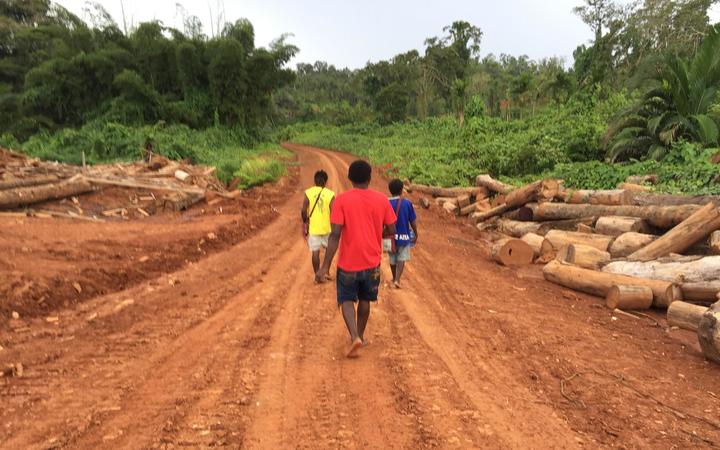
Landowners walking along a logging road in
an illegally logged forest, Metamin area,
New Hanover, PNG. Photo: Global Witness Media Hub

PNG has struggled to contain illegal logging over recent decades, but the government is seeking more benefits from licensed logging, with Marape recently telling foreign logging companies to start downstream processing activities in PNG or leave the country.

"Our rainforest is the oxygen factory of the world, therefore, it is a global asset. To conserve, we must all work together to find a balance that will preserve the rainforest while improving livelihood."

According to the PNG government, data taken from the Global Forest Watch Forest Monitoring programme has revealed that only 36 percent of earth's 14.6 million square kilometres of tropical rainforest remain intact.

The balance of 64 per cent is either degraded or completely gone.

Source: RNZ

PNG PM urges more care from advanced economies on climate

 Papua New Guinea's prime minister has called on developed nations to show more care towards island states impacted by climate change.

Papua New Guinea Prime Minister James Marape and the United Nations' Resident Co-ordinator Gianluca Rampolla cut cake at a Partnership Dialogue in Port Moresby to mark 75 years of existence of the UN, 3 November 2020.

Papua New Guinea Prime Minister James Marape and the United Nations' Resident Co-ordinator Gianluca Rampolla cut cake at a Partnership Dialogue in Port Moresby to mark 75 years of existence of the UN, 3 November 2020. Photo: PNG PM Media

James Marape was speaking at a Partnership Dialogue to mark 75 years of existence of the United Nations.

The prime minister called for greater international collaboration to address the impacts of climate change in the Pacific.

While he cited PNG's own low-lying atolls and coastal areas, he also singled out Micronesian and Polynesian Islands as being particularly vulnerable.

According to him, having caused the greater environmental damage, nations with advanced economies owe "a little bit more care" and restitution to Pacific island states.

He urged the UN to facilitate discussions on greater assistance to islands states impacted by climate change and for technologies that can help them reclaim land.

"I ask the United Nations to coordinate this discussions without fear or favour," he said at the Dialogue event at APEC Haus in Port Moresby.

"If the UN is to advance into the next 75 years, carry the rights of every member states, including the Smaller Island States, the right to leave on their own land and not immediately look at relocation."

Marape said the collective carbon foot prints of Smaller Island States were nothing compared to the carbon footprint of industrial nations.

"I would like to press on here, on the 75th anniversary of the United Nations, that advanced nations owe a little bit more care and restitute [sic] to the low lying atolls and coastal areas of our country and the Smaller Island States of the Pacific Region."

Marape said that as well as PNG he was speaking for the 15 other smaller Pacific Island states.